From One Sentence to a Finished LitRPG Book
Published October 1, 2026
You’ve got a character, a dangerous world, and a satisfying idea for how they’ll gain power.
Then you start designing the system.
By midnight, you have fourteen attributes, three currencies, and a spreadsheet that requires a small government to maintain. Your main character still hasn’t left the starting room.
How do you turn one LitRPG idea into a complete book?
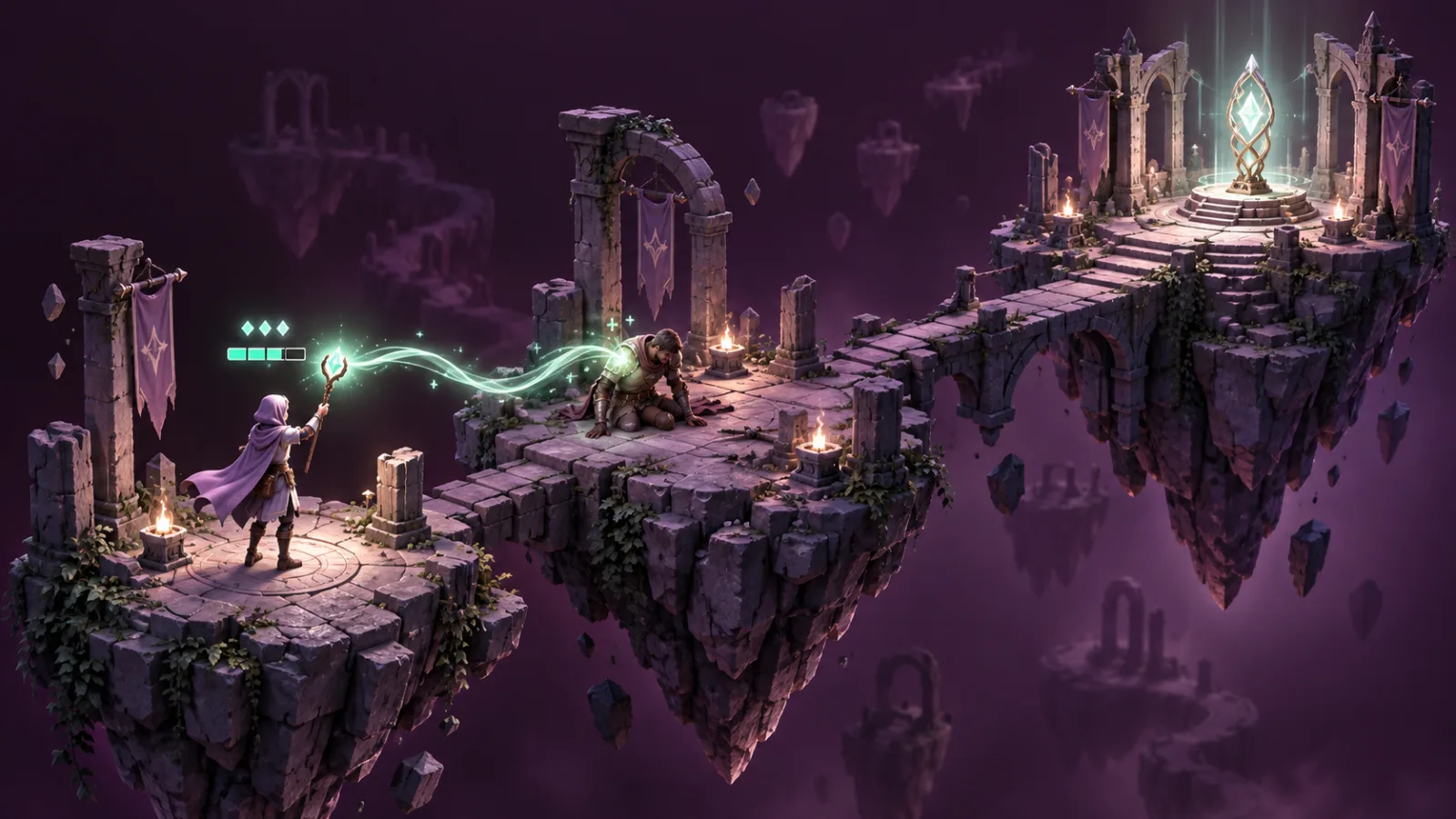
How do you turn one LitRPG idea into a complete book?
Build a manageable story around the progression, then develop it chapter by chapter. Lorika’s writer’s assistant gives you a guided route through the premise, characters, synopsis, and manuscript. Your decisions keep the game mechanics connected to something a reader can care about.
Let’s work through an original example. This is an illustrative book plan, not a report of a timed product test.
Begin with a sentence that contains a problem
Here’s our starting idea.
A failed apprentice healer enters a dungeon where she gains experience only by keeping other people alive.
The premise gives us a person, a situation, and a progression rule. It also suggests conflict. A character rewarded for survival will have a difficult relationship with companions who treat every locked door as an invitation to hit something.
We’ll call the healer Mara. Her immediate goal is to earn enough from the expedition to recover her family’s medical shop. She can’t do that from the entrance, and she can’t survive the dungeon alone.
That is enough to begin shaping a book.
In Lorika, describe your LitRPG premise in the brief and choose story settings that suit the central situation. Include the experience you want the reader to have. This might be a tense adventure with resourceful problem-solving, uneasy friendships, and progression that costs something.
You don’t need to name every dungeon floor yet.
Choose a small system with meaningful limits
Mara’s starting system can use three visible elements.
A level that records her progress.
A limited pool of healing energy.
A short list of skills that change what she can do.
The important part is the relationship between the rules and her choices.
If healing energy instantly returns whenever she rests, the group might sleep after every injury. If recovery requires a safe room and safe rooms are scarce, deciding when to push ahead becomes interesting.
Give the first skill a clear limit. Mara can close a wound, but she cannot replace lost blood. That means an injured companion may still need protection, slower travel, or someone willing to carry their equipment.
A rule has entered the story because it changes behavior.
Write down the limits you intend to use. You are establishing material to review as the book develops, rather than expecting a growing set of numbers to police itself.
Make progression answer the story’s pressure
A level-up is most useful when the reader understands why it matters now.
Imagine Mara gains a skill that lets her share pain with an injured companion. Earlier, she could only heal people who stayed still. Now she can keep someone moving through danger, but must accept part of the injury herself.
The new ability expands her options and creates a harder decision.
It also connects with her personal problem. Mara believes she must make herself useful to deserve a place in the group. A skill that rewards taking everyone’s suffering could deepen that belief before she learns where its limits should be.
This gives the progression two jobs. It changes what she can do in the dungeon and puts pressure on how she sees herself.
When you review proposed story directions in Lorika, look for that connection. A sequence of increasingly large enemies may provide events. The stronger direction gives those events consequences for the person fighting them.
Build the group around conflicting needs
Mara needs companions who make her choices difficult for reasons beyond poor health.
One fighter values speed because another team is approaching the same prize. A scout wants to avoid the route where her brother disappeared. A wealthy novice assumes healing is a service he has already paid for.
Nobody needs a complete biography at this stage. Each needs a want that affects the expedition.
Lorika’s character cards give you places to define personality, relationships, wants, fears, and speech patterns. Use those details to establish how the group will behave under pressure.
Mara might apologize before giving an order. The fighter might answer practical questions with practical answers, then become evasive when asked why speed matters so much. The scout might describe danger precisely while refusing to describe her brother at all.
Those distinctions will help when a chapter contains more than one person with a sword and an opinion.
Give this book a finish line
A series may eventually take Mara across an entire continent. This book needs an ending you can recognize.
Perhaps the expedition must retrieve a medical relic from the dungeon’s lowest accessible chamber. Mara expects the relic to restore her family’s shop, only to discover that removing it will leave the injured expedition members without their final safe room.
Now the ending demands a choice connected to the beginning.
Will she secure the future she wanted by abandoning people who depend on her? Can she find another solution using what she has learned? What will that solution cost?
You can leave the wider dungeon unexplored. You can leave another expedition waiting outside. The central journey still needs a result.
A bounded finish line makes the synopsis easier to judge. It also gives you a way to notice when the story begins adding adventures that delay the same decision without deepening it.
Read the synopsis for cause and consequence
Once the setup develops into a synopsis, follow the connections between its events.
Mara heals the fighter, so she lacks energy for the flooded passage. The group takes another route, which brings the scout near her brother’s last known location. The scout withholds information, and that silence causes a preventable loss.
Each development grows from something already in motion.
If the synopsis instead jumps from one unrelated monster to another, look for the missing connection. What did the previous encounter change? A resource, a relationship, a belief, a route?
Review the setup before you proceed. You might remove a second rival party, combine two supporting roles, or decide the relic should matter to someone besides Mara.
These changes are easier to understand while the book’s central direction is still visible as a whole.
Develop chapters that do different work
A complete LitRPG book needs more than variations on entering a room and winning a fight.
One chapter might establish a rule through a small failure. Another might force the group to negotiate. Another might reveal why a companion has been taking unreasonable risks.
Before developing the next chapter, identify what should change by its end.
For example, Mara may enter a scene assuming the fighter is reckless. She leaves knowing he has promised to return with medicine before his daughter’s condition worsens. His behavior remains difficult, but her understanding changes.
That gives the following chapter something new to work with.
Lorika develops the manuscript through chapters organized into parts or blocks. As you read and continue, use the chapter summaries and project information to stay oriented. Decide whether each new section belongs to the same journey you set out to tell.
Let the numbers appear where they matter
A stat update can make a victory satisfying. It can also interrupt a conversation that was finally becoming interesting.
Choose what the reader needs to see in that moment.
When Mara gains her first useful skill, the exact change deserves attention. When an attribute rises slightly during a routine passage, a brief acknowledgment might be enough. If a statistic will decide the climax, establish its meaning before the climax asks us to care.
Avoid making the reader calculate whether the scene is plausible.
Suppose Mara has enough energy for two major heals. Show that limit before three people are injured. The reader can feel the dilemma immediately because they already understand the shortage.
The pleasure comes from anticipating a difficult choice, not from discovering a surprise exception buried in a status screen.
A simple reference can keep those details readable during your review. Record the skill, its cost, its limit, and the first chapter where Mara can use it. If sharing pain requires consent, record that condition too.
Now compare the decisive scenes with those facts. When Mara helps an unconscious companion, the consent rule creates a real question you must answer. Does an earlier agreement cover this situation? Does she need another method? Solving that question can produce a better scene while keeping the system understandable.
Review mechanics and emotion together
As the chapters accumulate, check the system against the actual scenes.
Can Mara still perform a skill she supposedly lost? Does an exhausted companion recover without an explanation? Has a minor item quietly acquired the ability to solve every problem?
Then ask what the same events do to the relationships.
If Mara accepts pain to save someone, do they respond? If the fighter disobeys her and another person suffers, does that affect their trust? A consequence that vanishes after the paragraph makes the earlier tension feel temporary.
Keep necessary corrections focused. Sometimes a line establishing rest fixes a resource problem. Sometimes the scene needs a different solution because the current one avoids the cost you promised.
You are checking whether the book honors its own rules and its own people.
Make the final choice use what came before
At the relic chamber, Mara should not discover an entirely new power that conveniently solves the ending.
She might instead combine established skills in a way she previously feared. She could share pain across willing companions, allowing the group to move together while she carries the relic. The solution works because they have learned to cooperate, and because Mara finally asks for help rather than volunteering to absorb everything herself.
That outcome pays off the progression, the relationships, and her personal journey.
The book can still surprise the reader. Surprise becomes more satisfying when they can look back and see the pieces that made it possible.
Give the immediate aftermath room too. Who is changed? What has Mara gained? What did the group lose? What does recovering the shop now mean to her?
The last page should belong to this story before it advertises the next one.
Read the completed book as a continuous experience
Once the chapters reach the ending, step back from individual improvements and read for the whole journey.
Does the opening introduce the kind of book the ending delivers? Are the rules understandable before they become decisive? Do quieter chapters develop pressure, character, or meaning rather than merely postpone the next event?
Look for places where the same explanation appears repeatedly. Check that a relationship advances instead of returning to its original state after every disagreement. Notice whether a promised discovery ever receives an answer.
Then make the revisions that strengthen the book you actually wrote.
You may discover that the first chapter needs less background because later scenes explain the system more naturally. You may decide a companion’s final choice deserves an earlier moment of doubt. Those are useful changes, grounded in a story you can now see from beginning to end.
Your sentence can become something you finish
You don’t need a perfect system before you begin. You need a premise with pressure, rules you can follow, and a finish line that gives the progression somewhere to go.
Lorika provides the guided structure for developing those choices into chapters. You provide direction, read the result, and shape the book as it grows.
Mara began as a healer with an inconvenient way of earning experience. A clear goal, limited mechanics, and a difficult final decision gave that sentence a complete journey.
Your idea deserves the same chance to move beyond the notes folder.
Start your LitRPG book in Lorika with one premise and the few rules that make its first problem interesting.