Your First Book Starts Here, Even If You’ve Never Written Before
Published September 27, 2026
You can picture the person running through the market. You know what’s in their bag. You’ve even imagined the moment they realize someone is following them.
Then you open a blank document.
Suddenly, you’re wondering whether you need an outline, a writing course, or a more impressive desk.
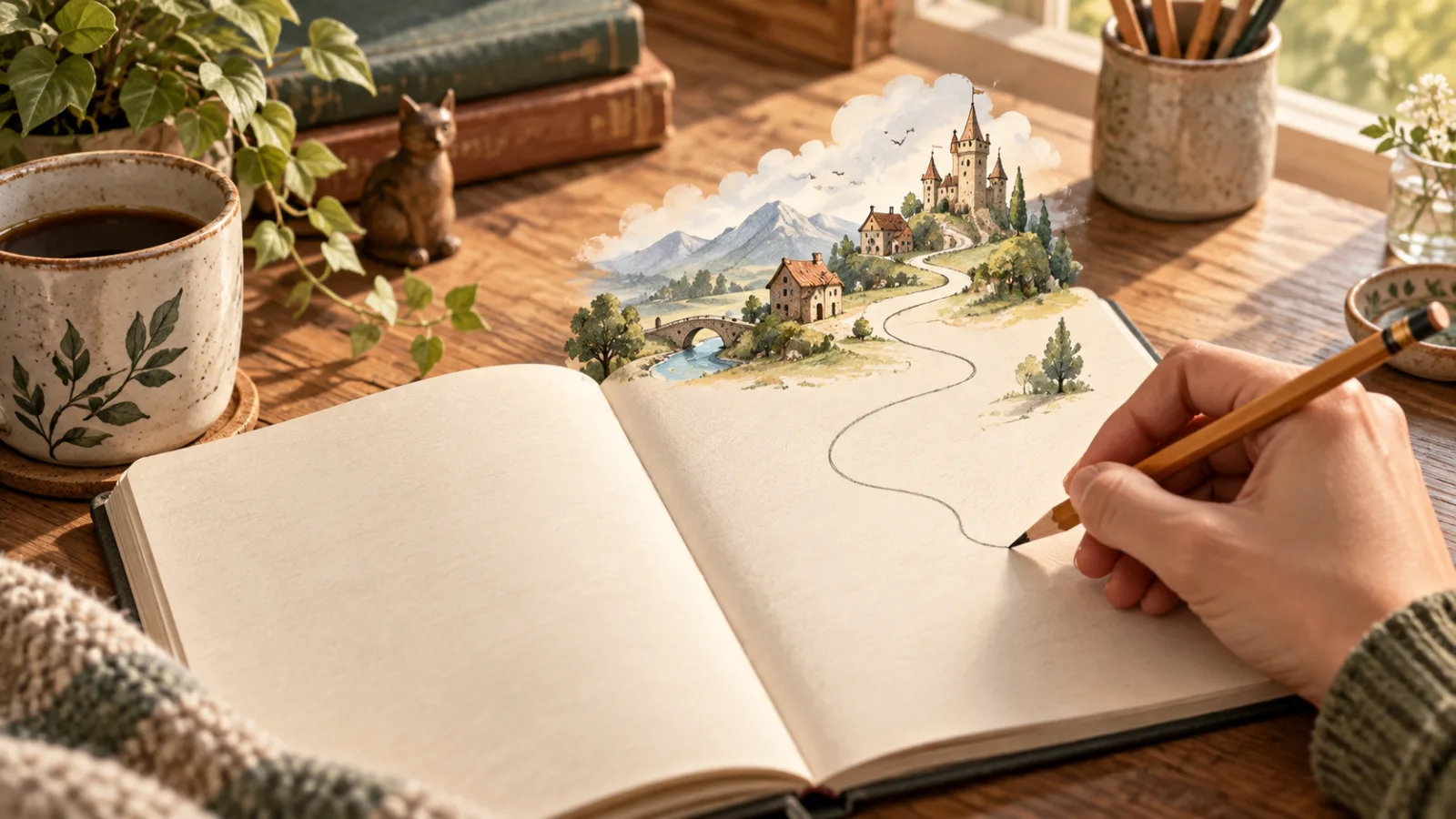
Where do you start when you’ve never written a book before?
Start by describing the story you want.
Give your idea a person and a problem
Imagine this original adventure premise.
A market delivery girl finds a map sewn into a stranger’s coat and discovers that someone is destroying every place it marks.
There’s room for a book here. There’s also plenty we haven’t decided. Who made the map? Why are the places disappearing? Does the girl want to get involved?
Those gaps give you useful decisions to make. They don’t disqualify the idea.
For your own starting description, name a person, something that interrupts their life, and a reason they can’t simply walk away. Perhaps our delivery girl recognizes the next marked location as her brother’s house.
Now following the map matters to someone.
Choose the experience you want to create
Think about what you enjoy reading. A tense escape? A warm adventure with strange companions? A mystery that makes you suspicious of absolutely everyone, including the helpful baker?
Choosing a genre in Lorika gives the project an initial direction. Narration and mood choices help describe the experience you want. First person might put us inside the delivery girl’s hurried thoughts. Third person might let us watch her misread the stranger at the corner.
You don’t have to solve every possibility. Choose what suits the book you’re excited to read.
Then give the project a working title. Working is the useful word. A title can hold your place while the story discovers what it is.
Let the questions make the idea clearer
Lorika’s guided setup helps you describe the premise and explore possible directions. When you review a suggestion, look for the version that makes you want to know what happens next.
You can also notice what feels wrong.
Maybe the delivery girl becomes a royal heir in a proposed direction, but you liked her because she was an ordinary person caught in something enormous. Keep that preference. It tells you something important about your story.
The same applies to character details. Give her a practical want, a fear, and a reason to act. She wants to save her brother. She fears being responsible for another failed rescue. She acts because the next marked place gives her a deadline.
That is useful material. Her favorite soup can wait.
Review what you’re about to build
Before moving ahead, read the setup as a reader rather than as someone completing a form.
Can you explain what the main character wants? Does the proposed direction still feel like your idea? Is there an obstacle strong enough to make the journey interesting?
Make the changes that matter, then begin developing the chapters. Your job continues as you read, choose, and edit. A finished book comes from carrying those decisions through to an ending you’re happy with.
For now, the next step is smaller.
That scene in your head needs somewhere to begin.
Start your first book in Lorika with a short description of the person, the problem, and what happens if they do nothing.